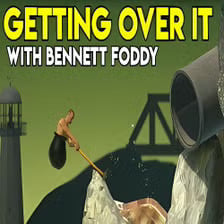
Getting Over It with Bennett Foddy is a physics climbing game about moving a man in a cauldron up a mountain with a long hammer. The mouse controls the hammer rather than the character’s body. Touching the hammer head to the terrain creates the force for pushing, pulling, swinging, or launching upward. Getting Over It with Bennett Foddy has no inventory, combat system, or alternate route selector; its work is learning one physical control well enough to keep gaining height.
The hammer
Moving the mouse rotates and extends the hammer around the cauldron. A slow movement can place the head on a narrow edge. A fast pull can lift the pot toward that contact point. Pushing down against solid ground can launch the character into the air. The same motion behaves differently when the head slides across a curved or steep surface.
The game does not translate a gesture into a guaranteed climb animation. The hammer and pot collide with the level geometry, and momentum continues after contact. A large mouse movement can turn a careful grip into a swing past the intended ledge. High pointer sensitivity may make placement harder, while very low sensitivity can require more physical movement for quick recoveries.
Falls stay fallen
The mountain is continuous. Getting Over It with Bennett Foddy does not divide it into ordinary stages that reload after a mistake. Falling from a high section can return the player to terrain visited much earlier. The loss is part of the saved position rather than a temporary failure screen.
That design changes how progress feels. Reaching a new object proves that the route is possible, but it does not establish a protected checkpoint there. A hurried recovery can create a second fall before the pot settles. The safest response is often to stop moving, see where the hammer can make stable contact, and rebuild the climb from the new position.
Reading the terrain
Objects act as grips, ramps, barriers, and pivots. A branch can catch the hammer head, while a smooth wall may require momentum rather than a static pull. Some shapes leave room for the cauldron but not for a full hammer rotation. The player must plan where the hammer will travel after the pot moves, not only where it touches first.
Getting Over It with Bennett Foddy keeps the camera tied to the climb, so nearby geometry can enter or leave view during a rapid swing. A launch made without seeing its landing surface depends on remembered layout. The game rewards repeated knowledge of a section, but a slightly different angle can change the result because the physics interaction is continuous.
The spoken climb
Bennett Foddy narrates the attempt with observations about frustration, effort, and lost work. The commentary reacts to parts of the journey and can accompany a fall. It is part of the intended experience rather than an instruction system that explains every obstacle.
Completion time varies sharply with control practice. The developer reported a median of about five hours among playtesters while describing the upper end as effectively unbounded. That spread is plausible because one player can pass a section immediately and another can lose the same height repeatedly. Finishing Getting Over It with Bennett Foddy means reaching the top through the same physical rules; lowering difficulty does not replace them with automatic movement.